






1.0 // IDENTITYMONOJITGOSWAMI

Self-taught Backend Developer specializing in RAG based systems and high-performance Machine Learning pipelines.

2.0 // SYSTEM SPECS

Technical Capabilities & Core Architecture

Monojit Goswami
LIVE_FEED
1080p // 60FPS
SCANNING...

2.1 // SKILLS

PythonPython
CC
C++C++
JavaScriptJavaScript
TypeScriptTypeScript
SQLSQL
MongoDBMongoDB

2.2 // TOOLS

FastAPINode.jsSSEREST APIsRedisFirestoreSupabaseStreamlitFirebasePineconeChromaDBLangChainGit/Github

I am Monojit Goswami, a backend engineer driven by the potential of autonomous systems. My architecture philosophy focuses on efficiency, modularity, security, and scalability, building high-performance engines that bridge the gap between architectural stability and artificial intelligence.

I specialize in developing general-purpose, high-fidelity backend solutions and RAG-based agentic systems. By leveraging Vector databases and embedding models, I build context-aware applications that transform static data into actionable intelligence.

3.0 // ACTIVE MODULES

Explore My Projects & Innovations

Featured
Shiksha Saathi
Under DevelopmentGenAI/RAG

Shiksha Saathi

A production-grade RAG-based SaaS chatbot providing 24x7 student support for college-specific academic information.

Status: Under Development.

Category: GenAI/RAG.

Shiksha Saathi is a production-ready Retrieval-Augmented Generation (RAG) chatbot designed to assist college students with official academic information when administrative staff are unavailable. The system allows institutes to upload and manage knowledge sources such as notices, circulars, and policy documents through a dedicated admin panel. Administrators can update the knowledge base in real time, modify system instructions, monitor usage metrics, and intervene when the chatbot’s confidence falls below a defined safety threshold. To prevent misinformation in high-stakes academic contexts, the chatbot uses confidence-based query gating, handing off ambiguous or unsafe queries to human administrators. Analytics dashboards surface the most confusing topics, frequently missed notices, and unresolved student queries, enabling institutes to proactively address communication gaps.

Key features of Shiksha Saathi

  • Production-grade RAG chatbot for college-specific data
  • Real-time knowledge base management and dynamic system prompt control via admin panel
  • Confidence-threshold based human handoff to prevent hallucinations
  • Analytics dashboard for high-confusion and unresolved queries

Built with: python, FastAPI, Firestore, Transformers, Gemini API, Pinecone, Dropbox, Vercel, HTML/CSS, Vanilla JS.

Source code: https://github.com/monojitgoswami69/Shiksha_Saathi

pythonFastAPIFirestoreTransformersGemini APIPineconeDropboxVercelHTML/CSSVanilla JS
Featured
Campus Dost
Under DevelopmentGenAI/RAG

Campus Dost

A multi-tenant SaaS evolution of Shiksha Saathi, providing isolated RAG chatbot instances for multiple educational institutions.

Status: Under Development.

Category: GenAI/RAG.

Campus Dost is a multi-tenant SaaS platform built by extending the core architecture of Shiksha Saathi to support multiple institutions at scale. While Shiksha Saathi operates as a single-tenant system, Campus Dost introduces strict tenant isolation, allowing each institute to operate its own dedicated chatbot instance with isolated vector stores, configurations, prompts, and access credentials. All infrastructure, hosting, and scaling are centrally managed. The platform provides institute-specific admin panels with multi-role access control, enabling different levels of administrative privileges. This design ensures data security, operational independence, and safe AI behavior across institutions while maintaining a unified and scalable backend architecture.

Key features of Campus Dost

  • Multi-tenant SaaS architecture built on Shiksha Saathi core
  • Per-institute isolated chatbot instances
  • Dedicated vector stores and prompt isolation per tenant
  • Role-based access control with multi-role admin system
  • Centralized infrastructure, hosting, and scaling
  • Secure tenant-aware authentication and authorization

Built with: Python, FastAPI, Firestore, Gemini Embeddings, Gemini/Groq API, Firebase Auth, Pinecone, Dropbox, Vercel, React JS.

Source code: https://github.com/monojitgoswami69/campus-dost

PythonFastAPIFirestoreGemini EmbeddingsGemini/Groq APIFirebase AuthPineconeDropboxVercelReact JS
Featured
Codalyzer
CompletedGenAI

Codalyzer

An LLM-powered static code analysis tool that infers time and space complexity and suggests optimizations.

Status: Completed.

Category: GenAI.

Codalyzer is a static code analysis system that leverages large language models to analyze source code and infer time and space complexity. The tool parses code submissions, evaluates algorithmic patterns, and estimates computational complexity while remaining language-aware. When inefficient patterns are detected, Codalyzer generates targeted suggestions to improve performance, readability, and algorithmic efficiency. Designed for educational and screening use cases, Codalyzer helps developers and students understand complexity trade-offs and improve code quality without relying solely on manual reviews.

Key features of Codalyzer

  • LLM-based static code analysis
  • Automatic inference of time and space complexity
  • Language-aware code understanding
  • Actionable optimization suggestions
  • Educational feedback for algorithmic improvement

Built with: Python, FastAPI, Gemini/Groq API, Vercel, React TS, Redis.

Source code: https://github.com/monojitgoswami69/codalyzer

Live demo: https://codalyzer.mgbuilds.in

PythonFastAPIGemini/Groq APIVercelReact TSRedis
Featured
Collabify
Under DevelopmentFull Stack

Collabify

A real-time collaborative code editor with Monaco, Yjs CRDT synchronization, room management, chat, and GitHub repository import

Status: Under Development.

Category: Full Stack.

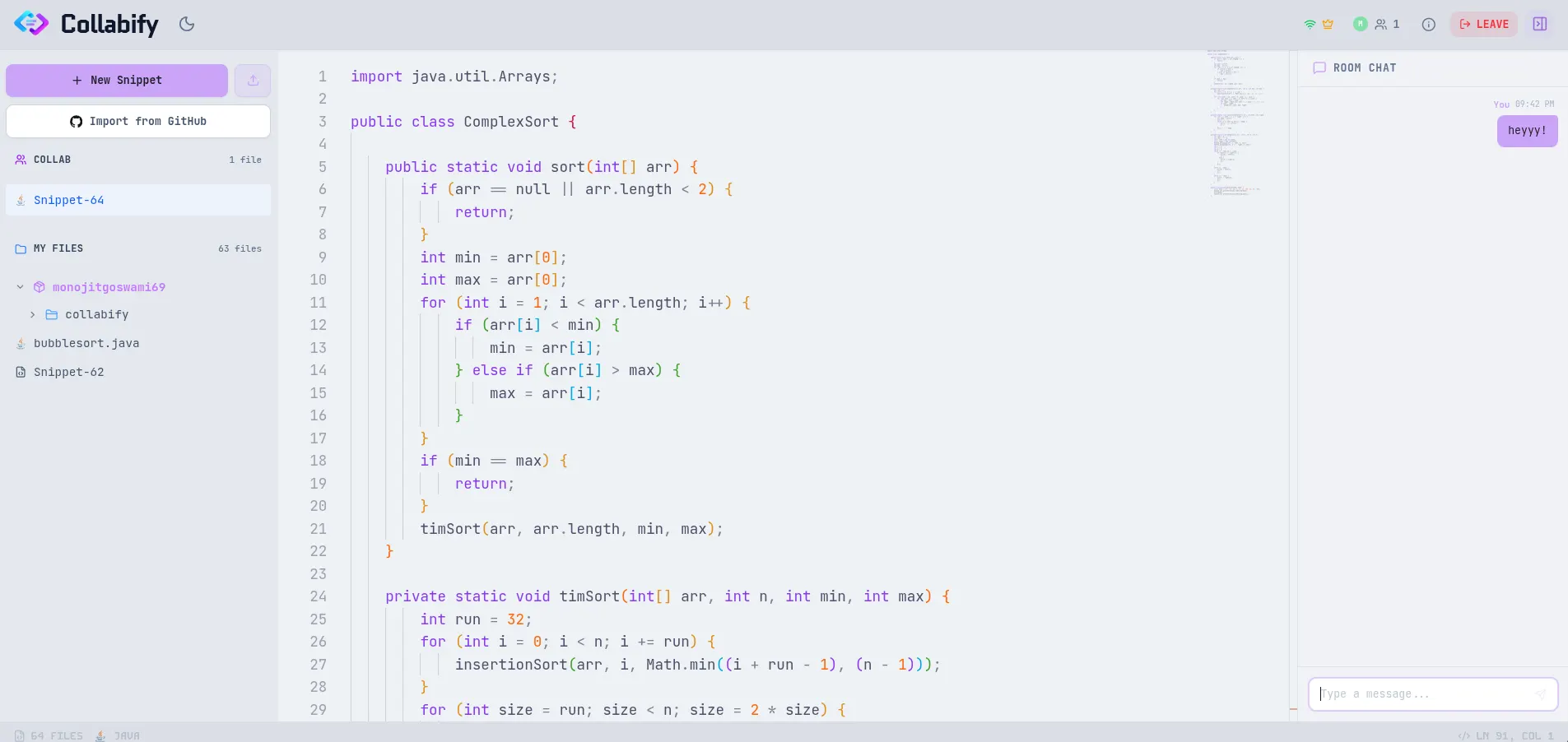
Collabify is a browser-based collaborative coding platform designed for lightweight, zero-install team coding sessions. The app combines a Next.js frontend with a dedicated Node.js WebSocket collaboration server. Users can create host-controlled rooms, share short room codes, approve collaborators, and edit shared files together in real time using Monaco Editor. Document synchronization is powered by Yjs CRDTs, enabling conflict-free concurrent editing with live cursor and selection awareness. The backend separates room control traffic from binary document sync traffic, using dedicated WebSocket channels for room lifecycle events, chat, file sharing, and per-file Yjs synchronization. Collabify also includes GitHub OAuth integration, allowing users to browse repositories and import files directly into the editor, including private repositories with the required scopes.

Key features of Collabify

  • Real-time collaborative code editing with Yjs CRDTs
  • Monaco Editor with VS Code-class editing experience
  • Live remote cursors and selection awareness
  • Host-controlled rooms with join request and approval workflow
  • Room-wide file sharing with per-file synchronization
  • Dedicated WebSocket channels for room control and document sync
  • Real-time room chat with peer identity and timestamps
  • GitHub OAuth authentication and repository file import
  • Support for private repository browsing with appropriate scopes
  • Local file persistence and language detection

Built with: Next.js, Node.js, React TS, Websockets, CRDTs, Monaco Editor, Github API.

Source code: https://github.com/monojitgoswami69/collabify

Live demo: https://collabify.mgbuilds.in/

Next.jsNode.jsReact TSWebsocketsCRDTsMonaco EditorGithub API
NEXUS
CompletedGenAI

NEXUS

A terminal-style portfolio chatbot with a controlled roast persona and strict conversational constraints.

Status: Completed.

Category: GenAI.

NEXUS is a terminal-style chatbot built for my portfolio website to answer queries strictly about my projects and technical experience. The system deliberately avoids RAG and instead operates on a static, tightly scoped context provided through controlled prompts. A constrained roast persona is layered on top of factual responses to maintain engagement without sacrificing correctness. To ensure reliability and prevent abuse, NEXUS implements per-user and global rate limiting using Redis, along with enhanced conversation history management to support multi-turn interactions within a bounded context window.

Key features of NEXUS

  • Terminal-style conversational interface
  • Controlled roast persona layered over factual responses
  • Strict prompt-scoped knowledge boundaries
  • Per-user and global rate limiting using Redis
  • Enhanced multi-turn conversation history management
  • Bounded context window to prevent drift and hallucinations

Built with: Python, FastAPI, Gemini/Groq API, Redis, React TS, Vercel.

Live demo: #chat

PythonFastAPIGemini/Groq APIRedisReact TSVercel
Certify
completedFrontend

Certify

A frontend-only mass certificate generation tool with template mapping, advanced typography control, and parallelized client-side processing.

Status: completed.

Category: Frontend.

Certify is a frontend-only mass certificate generation assistant designed to create large volumes of personalized certificates without any backend involvement. Users upload a certificate template and a CSV data file, then visually draw and position multiple text boxes over the template. Each box can be mapped to any CSV field and customized with fine-grained controls including horizontal and vertical alignment, font size, and typography selection from the Google Fonts library. To handle scale efficiently, Certify uses configurable web workers based on available CPU cores to parallelize rendering tasks, achieving up to a fivefold speedup compared to single-threaded execution. Certificate generation is split into batches of 3,000 to minimize memory overhead and prevent browser instability. All processing is performed entirely on the client. Templates, CSV data, and generated certificates never leave the user’s device, ensuring privacy and eliminating server-side costs.

Key features of Certify

  • Visual template editor with draggable text boxes
  • CSV-to-template field mapping
  • Advanced text customization with alignment and font controls
  • Access to 1900+ Google Fonts
  • Configurable web workers for parallel certificate generation
  • Batch-based processing to minimize memory usage
  • Fully client-side execution with no backend

Built with: React TS, JavaScript, HTML5 Canvas, Web Workers, Vercel.

Source code: https://github.com/monojitgoswami69/certify

Live demo: https://certify.mgbuilds.in

React TSJavaScriptHTML5 CanvasWeb WorkersVercel

5.0 // ESTABLISH SIGNAL

Connect & Collaborate

Currently available for freelance projects and full-time opportunities. If you have an interesting proposition or just want to discuss the future of AI, send a transmission.

© 2026 Monojit Goswami. All Rights Reserved.